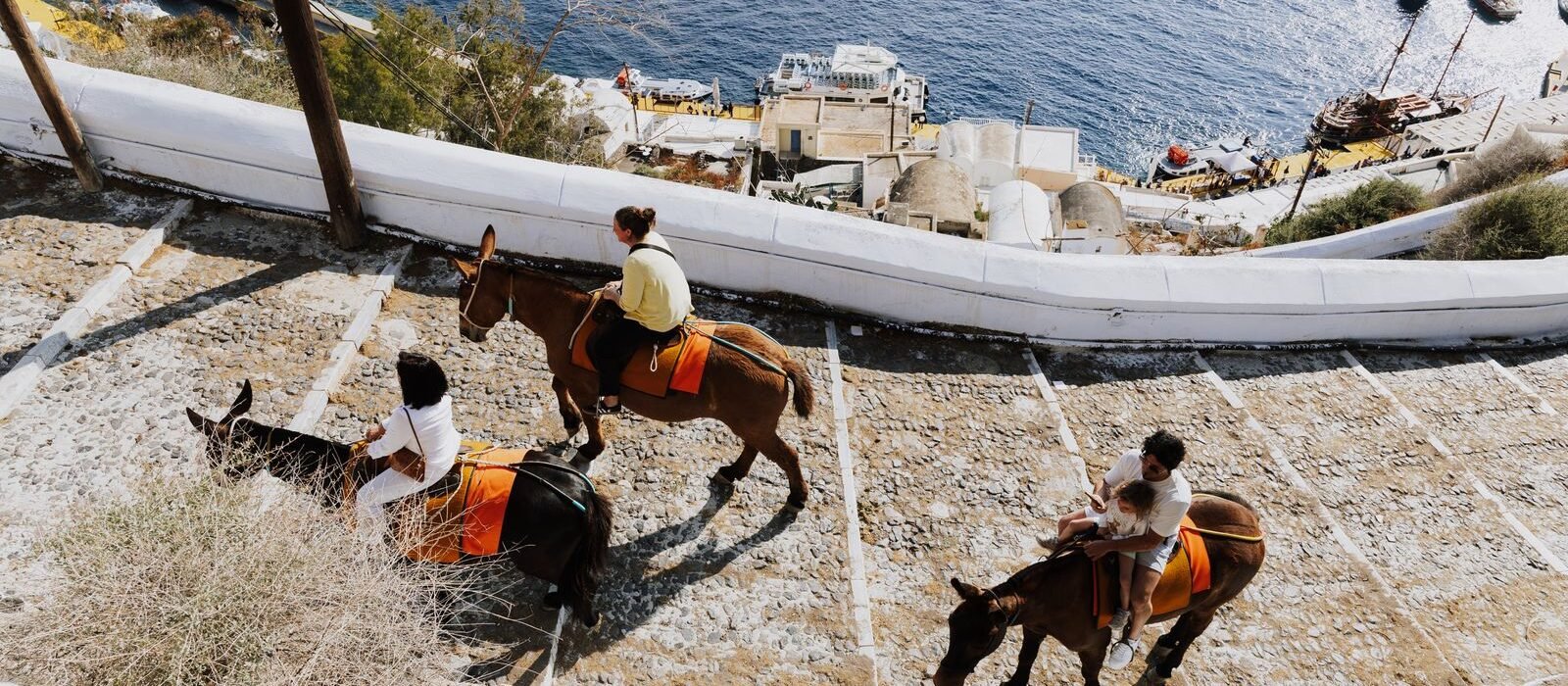
If you’re planning a trip to Santorini and wondering about donkey rides Santorini, let me be straight with you before you book anything: this is a more complicated topic than most travel sites will admit, and the situation has changed significantly over the past few years. What you see on those famous Fira steps tells you everything you need to know.
The Reality of the Fira Steps
The donkeys — and mules, which are actually what most of the animals are — work the 588 steps connecting Fira’s old port to the town above. In peak summer, July and August, temperatures regularly hit 35°C or higher. These animals carry tourists up and down those steps from roughly 7am until late afternoon. The path is steep, uneven, and covered in animal waste that bakes in the sun. It smells exactly like you’d expect.
I watched one mule in August 2024 carry a man who looked well over 120kg up that path. The animal was visibly exhausted. Its handler prodded it constantly. That image stuck with me, and it’s why I think anyone visiting in 2026 deserves honest information rather than a cheerful ‘authentic experience’ pitch.
What Greek Law Actually Says
Greece introduced weight restrictions for animals used in tourism — the limit is supposed to be around 100kg per rider, plus saddle weight. There are also regulations about working hours and rest periods. In practice, enforcement in Santorini has been inconsistent at best. A 2020 report by the Donkey Sanctuary flagged welfare violations including overgrown hooves, wounds from ill-fitting harnesses, and animals working without adequate shade or water breaks.
Get the Free Santorini Insider Guide
Where to watch the sunset without the crowds, which villages deserve your day, and what you need to book before you arrive.
By 2025, local authorities had made some improvements — there are now water stations and mandated rest periods mid-day during summer months. Whether every operator follows these rules is another matter entirely.
Should You Do a Donkey Ride at All?
Honestly? I’d skip it, and not just for ethical reasons. The cable car from the old port costs around €6 each way and takes about three minutes. It runs from roughly 6:30am to 10pm in high season. You get a view that’s arguably better than what you’d experience looking at the back of a mule’s ears. If the cable car is out of service (which does happen — it closed for maintenance for two weeks in September 2023), the steps are entirely walkable in 20-25 minutes if you’re reasonably fit. Water taxis also run from Fira’s old port up to Ammoudi Bay and Oia for around €10-15 per person.
That said, I understand the pull. These animals are woven into Santorini’s history, and some families have worked with them for generations. This isn’t a simple good-versus-evil situation.
If You Do Choose to Ride
If you decide you want the experience, there are ways to do it that are less harmful to the animals.
Pros
- Part of Santorini's cultural and visual heritage, with some families working with the animals for generations
- Ethical sanctuary alternatives (grooming, feeding, walking) available via platforms like GetYourGuide with no-riding filter
- Symbolic animal adoption programs (EUR 30–50) let visitors support welfare without participating in rides
Cons
- Animals work in temperatures of 35°C or higher in peak summer, with documented welfare violations including wounds and overwork
- Weight restrictions (100kg) and working-hour rules exist but enforcement has been inconsistent
- Cable car (EUR 6, ~3 minutes) or walking the steps (20–25 minutes for reasonably fit visitors) are easier and less ethically fraught alternatives
- Path is steep, uneven, and covered in animal waste that bakes in the sun
- Go early. Before 9am, temperatures are cooler and the animals have had rest overnight. By midday in summer, it’s genuinely cruel conditions.
- Check the animal’s condition. Look at the hooves — they should be trimmed and clean. Check for saddle sores or wounds around the girth area. If the animal looks lame or distressed, walk away and report what you saw.
- Be honest about your weight. If you’re over 90kg, please consider the cable car. This isn’t about judgment — it’s physics and animal welfare.
- Tip the handler directly. Many of these are family operations where the handler, not a tour company, keeps the money.
- Avoid operators who use whips or sticks aggressively. Light taps are traditional but repeated striking is different — trust your instincts.
Ethical Alternatives and Responsible Tours
Several tour operators now offer what they call ‘donkey sanctuary visits’ or ‘ethical animal encounter’ experiences that involve grooming, feeding, and walking with the animals rather than riding them. These have grown in popularity since 2023. You can find vetted versions of these through platforms like GetYourGuide, where they’re listed under Santorini animal experiences — just filter for ‘no riding’ options and read the reviews carefully before booking.
The Santorini Donkey Rescue and similar NGOs operate adoption sponsorship programs if you want to support the animals financially without participating in the ride industry. A symbolic adoption runs about €30-50 and covers feed and veterinary costs for several months.
What’s Changing in 2026
The Greek Ministry of Rural Development has signaled that stricter tourism animal welfare regulations could be introduced ahead of the 2026 season, partly driven by EU-level pressure. There’s ongoing discussion about limiting the number of animals allowed to work the Fira steps and introducing mandatory licensing for handlers. Nothing is confirmed as of early 2025, so check local news sources closer to your travel date — Ekathimerini in English is a reliable source for Greek regulatory news.
Some tour aggregators, including Viator, have begun filtering out operators flagged by animal welfare organizations. It’s imperfect, but it’s progress.
The Bottom Line
Santorini is genuinely one of the most beautiful places you can visit — the caldera views from Oia at 6pm are hard to forget. The donkeys are part of that visual and cultural landscape. But beauty doesn’t obligate you to participate in something that may cause suffering. Take the cable car, walk the steps with a cold Mythos in a bag for the top, or find an ethical encounter that lets you be near these animals without adding to their load. Your holiday, your call — but you’ll feel better about it.
Frequently Asked Questions
Are donkey rides in Santorini cruel?
What is the weight limit for donkey rides in Santorini?
How much does the Santorini cable car cost and when does it run?
Are there ethical donkey experiences in Santorini that don't involve riding?
Will donkey rides still be available in Santorini in 2026?
More Things to Do in Santorini
Top-rated experiences with free cancellation and instant confirmation.
Related Articles
Planning a Santorini family vacation takes more preparation than the average romantic getaway, and that gap between expectation…
Santorini vs Mykonos: An Honest Breakdown for 2026 I’ve done both islands more times than I care to…
Santorini’s 14 villages couldn’t be more different from each other — the same small island holds a cosmopolitan…