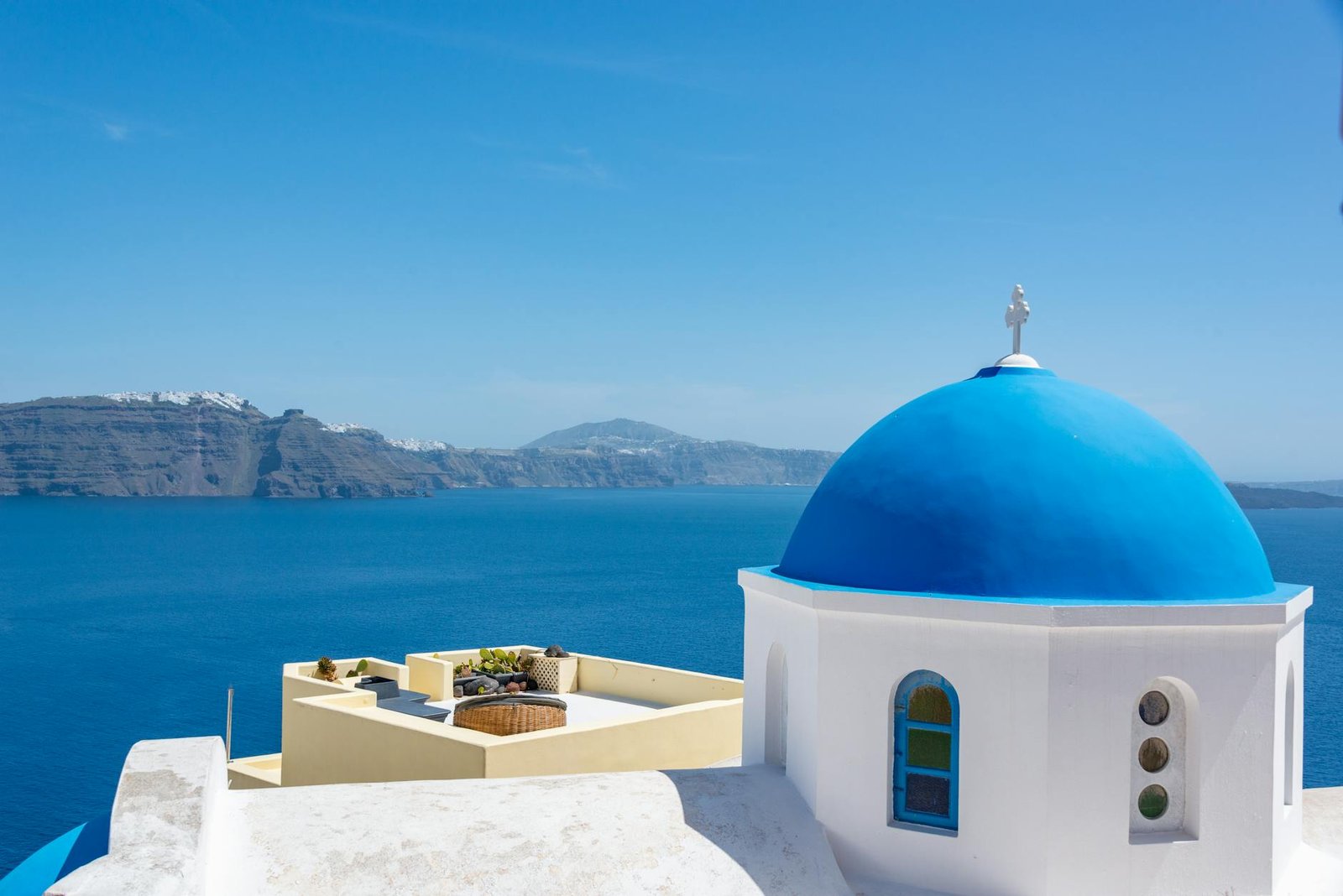
You’ve seen the photos a thousand times. White walls, blue domes, cobblestone alleys catching that particular Aegean light. But standing there in person, I kept asking myself — why is Santorini white and blue? The real answer is stranger, and honestly more interesting, than the postcard version.
Did You Know? The Colour Wasn’t Always Blue and White
This stopped me cold when I first learned it: Santorini’s iconic blue-and-white colour scheme was not a tradition that goes back centuries. For most of the island’s history, buildings were painted in earthy ochres, terracottas, deep reds. Blue domes were rare. The exception, not the rule.
So what changed? Two things: a military dictatorship, and a very practical need to stay alive.
The Ottoman Connection: Where White Began
During the Ottoman occupation of Greece (15th century through independence in the 1820s), the Greek government-in-exile — and later the Greek state itself — pushed islanders to paint their homes white as a symbol of resistance and Greek identity. White meant purity, Orthodox Christianity, Greekness. It was political before it was aesthetic.
Get the Free Santorini Insider Guide
Where to watch the sunset without the crowds, which villages deserve your day, and what you need to book before you arrive.
On Santorini specifically, whitewash served a grimmer purpose. Lime-based whitewash (ασβέστης / asvesti) is naturally antibacterial. Before modern medicine, coating walls, floors, even streets with lime kept disease from spreading. Every spring, islanders would re-whitewash their homes. Not for Instagram. For survival. The tradition held for generations.
The Science: Why White Works on a Volcanic Island
There’s cold logic underneath the beauty. Santorini’s volcanic rock — pumice and dark tuff — absorbs heat like a sponge. A dark stone house in the Aegean summer becomes an oven. White reflects up to 80% of solar radiation, keeping interiors liveable without a single air conditioning unit. When summer temperatures routinely hit 35°C, this wasn’t an aesthetic choice. It was engineering.
Add walls that run 50–80 cm thick, carved from the same volcanic stone, and you’ve got something remarkable. Santorini’s architecture is, in effect, ancient passive climate control. Cool in July. Warm in January. No electricity required.
The Blue Domes: A Law Was Passed
Here’s what most tourists photographing those domes in Oia will never know. The blue was mandated by law.
In 1967, the military junta running Greece — the “Regime of the Colonels” — issued a decree requiring the Cycladic islands to paint buildings in blue and white. The colours of the Greek flag. The stated goal was to promote national identity and Greek tourism. The result, decades later, is the unified aesthetic drawing millions of visitors every year.
Before that decree, Santorini’s domes came in all kinds of colours. The deep Aegean blue you’re desperate to photograph is, at its core, a political invention that became a cultural icon. Make of that what you will.
Why That Specific Shade of Blue?
The deep cobalt of the domes traditionally came from lapis lazuli pigment mixed into whitewash — historically expensive, which is exactly why it was reserved for church domes (representing heaven, the sky). Cheaper versions used copper compounds instead.
Today, Santorini Blue is a protected architectural standard. Oia, Fira, Imerovigli, Firostefani — caldera villages all — must follow strict colour codes. No bright reds, no greens, no modern finishes. The Greek Central Archaeological Council enforces this to protect what’s been recognised as a significant cultural landscape. Break the rules and expect a serious conversation with bureaucracy.
Did You Know? Santorini’s Architecture Has a Name
What you’re looking at across the caldera is called Cycladic architecture — one of the most distinct vernacular building traditions anywhere. Its defining features tell the story of people solving hard problems with limited resources:
- Cave houses (yposkafa) — built directly into the volcanic cliff face, using the rock itself as insulation
- Barrel-vaulted roofs — semicircular stone ceilings that distribute weight without timber (scarce on a treeless island)
- Flat roofs (doma) — used as terraces, for collecting rainwater, and drying produce
- Minimal windows facing the caldera — to reduce wind exposure from the famous Meltemi winds
- Interconnected terraces — houses stacked up the cliff, sharing walls and rooftops
The Volcanic Material Beneath the White Paint
Scratch below the whitewash and you find extraordinary stuff. Santorini’s buildings are made from:
- Thera pumice — ultra-lightweight volcanic rock, easy to carve, naturally insulating
- Volcanic ash bricks — used since ancient times, surprisingly durable
- Pozzolana cement — a volcanic powder mixed with lime, first used by the Romans. Santorini’s version (called Santorin earth) is still used in high-durability marine construction today
The island is literally built from its own catastrophe. The same volcanic eruption that tore the caldera open provided the building material for every house you see clinging to that cliff. There’s something almost poetic about that.
Oia vs Fira: Subtle Architectural Differences
All the caldera villages share the white-and-blue palette, but spend a few days moving between them and the differences become obvious:
- Oia — more blue domes, more “captain’s houses” (large cubic mansions built by wealthy sea merchants), many cave homes carved straight into the northern cliffs
- Fira — denser, more urban, decidedly more commercial. Fewer blue domes, more modern concrete hiding under the whitewash
- Imerovigli — the highest point on the caldera rim, the most peaceful and residential. Architecture closest to traditional Cycladic, and mercifully quieter
- Pyrgos — inland, no caldera views, but the most authentically preserved medieval village on the island. Venetian tower houses, labyrinthine alleys, almost no tourist crowds
Tips for Photographing Santorini’s Architecture
If you want those shots without fighting through selfie sticks:
- Arrive before 7am — Oia’s blue domes are empty and the light is genuinely perfect
- Shoot from below — take the path down to Amoudi Bay for a completely different angle on Oia’s domes against the caldera
- Explore Firostefani — 10 minutes’ walk from Fira, same caldera views, a fraction of the crowds
- Visit Pyrgos — the maze of alleyways gives you photography gold with almost zero competition
- Use the blue hour — 30 minutes before sunset, white walls turn deep amber and the blue domes seem to glow from inside
The Bottom Line
Santorini’s white and blue is not some ancient, unbroken tradition — it’s a 200-year-old practical solution shaped by Ottoman history, volcanic geology, Greek nationalism, and one military decree, slowly transformed into one of the world’s most recognisable landscapes.
Next time you raise your camera at those blue domes, you’re not just framing a pretty view. You’re looking at centuries of human ingenuity, survival, and identity layered in whitewash and volcanic stone.
That’s Santorini. Always more than it appears.
Frequently Asked Questions
Is the white and blue paint actually traditional or a modern tourist marketing thing?
Can I paint my house white and blue if I own property in Santorini?
Why specifically blue and not other colors?
Do all houses in Santorini have to be white and blue?
How often do locals repaint their houses white and blue?
More Things to Do in Santorini
Top-rated experiences with free cancellation and instant confirmation.
Related Articles
Updated July 2026: Update — July 2026: Greek Easter fell on April 20th this year, and the island…
Updated July 2026: Update, July 2026: The museum is open daily through the summer season, but mornings before…
Picking the Right Base in Santorini Matters More Than You Think Most people book a cave hotel in…