Santorini’s 14 villages couldn’t be more different from each other — the same small island holds a cosmopolitan clifftop capital, medieval fortresses, fishing harbours, beach resorts, and inland farming villages where traditional life continues almost unchanged. This guide covers every village worth knowing.
Oia — The Famous One
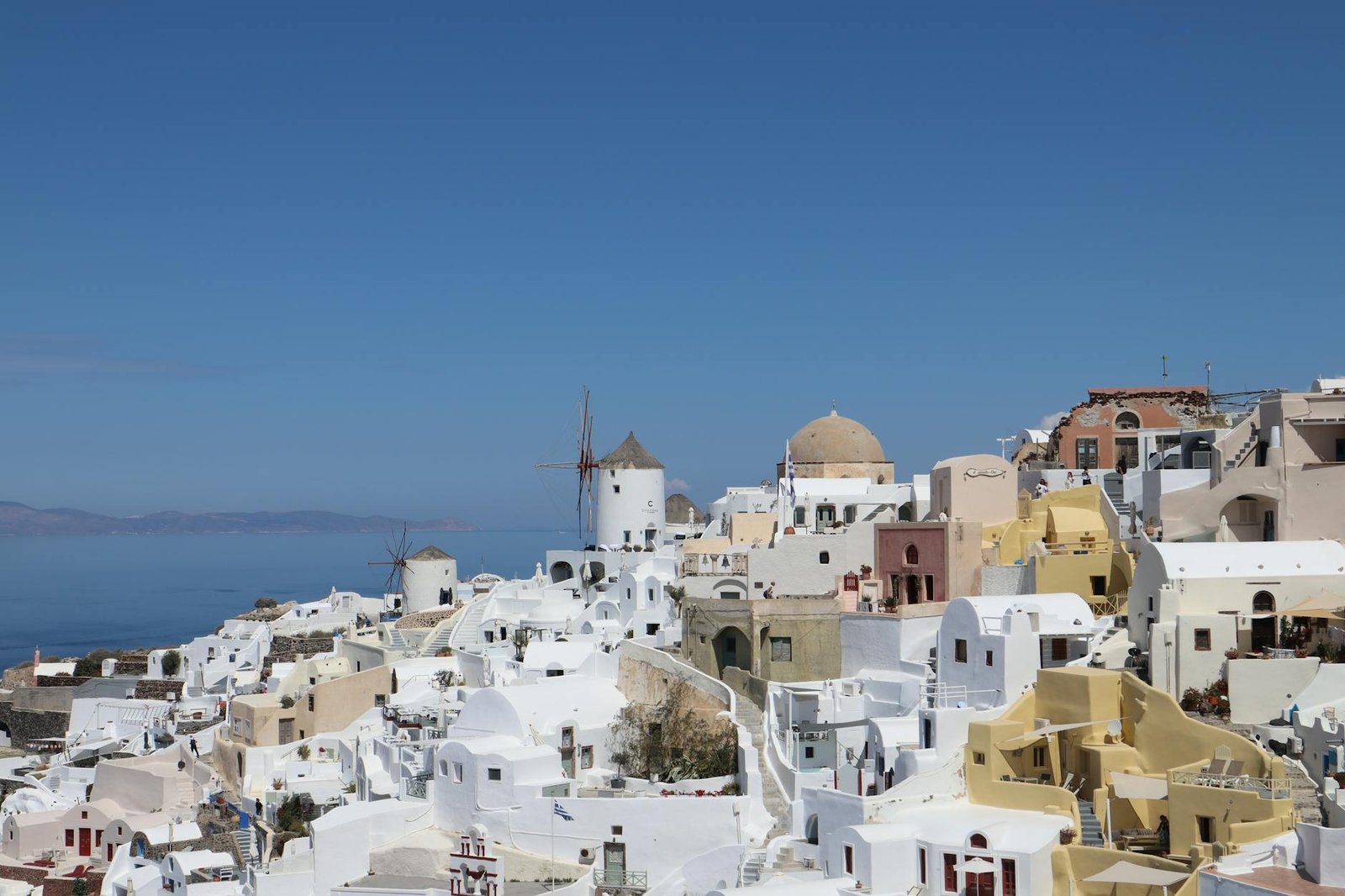
Top PickOia was Santorini's first commercial port and home to one of the Aegean's most powerful naval forces — at its 19th-century peak, local ship captains owned 130 vessels trading across the Black Sea and Mediterranean. The wealth is obvious the moment you look down at your feet. The lanes here are paved with marble, not volcanic stone, brought in by ship owners who could afford better. The famous blue domes, the captains' mansions (kapetanospita) with their caldera-view verandas, the cave houses (hyposkafa) carved straight into the cliff — together they've created the architectural image that defines Santorini worldwide.
Today, Oia is the island's most photographed village, and the sunset reputation is completely justified. The small sheltered harbour at Ammoudi Bay sits at the bottom of 214 steps and has three fish tavernas that are genuinely excellent. Best time to visit: Before 8am or after 8pm — between those hours in summer, the village is a slow-moving wall of people and selfie sticks.
Fira — The Capital
Fira became the island's capital by general agreement after the 1956 earthquake badly damaged Imerovigli, the previous capital. It's not the prettiest village on the caldera rim, but it's the one that actually functions like a town. Banks, pharmacies, supermarkets, the KTEL bus station, the cable car to the old port, and two of Santorini's most important museums — the Museum of Prehistoric Thera and the Archaeological Museum — are all here.
The caldera views from Fira's edge are magnificent, nearly as dramatic as Oia's, and the nightlife is the best on the island, with bars right on the caldera rim and clubs running until 6am. The Orthodox Cathedral of Ypapanti (1827) and Catholic Cathedral of Saint John the Baptist (1823) stand close to each other near the town centre — easy to miss if you're only following the crowd toward the view. Best for: Accommodation with island-wide access, nightlife, museum visits, and practical needs.
Imerovigli — The Balcony of Santorini
The name tells you everything — "Imera" (day) combined with "Vigla" (from the Latin "vigilare," to watch). This was the island's daytime lookout post, and it sits at the highest point of the inhabited caldera rim. The view here is arguably better than Oia's. You can see the full arc of the caldera in both directions simultaneously — north and south at once.
The medieval Skaros kasteli served as the main administrative centre of Venetian-era Santorini until the 1956 earthquake destroyed it completely. The ruins are accessible via a 30-minute hike out onto a dramatic volcanic promontory, and on most days you'll have the place almost entirely to yourself. Best for: Honeymooners, photography, and anyone who wants Oia's atmosphere without the crowds. Equivalent caldera hotels here often come in cheaper than in Oia.
Firostefani — The Postcard Village
The first photograph ever to appear on a Santorini postcard was taken here — that classic shot of a blue dome with the volcano sitting behind it. Firostefani is a 10-minute walk from Fira along a caldera path with extraordinary views the whole way. It's quieter, less tourist-dense, and has some of the island's best caldera views at prices that are noticeably more accessible. Honestly, if you're staying on the caldera rim on a budget, this is where to look first.
Pyrgos — The Medieval Fortress Village
Pyrgos sits at the island's highest elevation and was Santorini's capital until 1800, one of five Venetian kastelia built across the island. The original single entrance gate, the Kasteloporta, still stands. Above the gate there's a projecting stone slot called the "fonissa" — the killer — through which defenders once poured boiling oil on attackers. Underground escape tunnels run beneath the kasteli. This place was built by people who expected to be attacked, and it shows in every detail.
The square in front of the castle entrance, once reserved strictly for village aristocrats, now has a war memorial and small cafes. Forty-nine churches and chapels serve the village and surrounding area. The Good Friday celebration here — tin lamps lit throughout the entire village — is the most atmospheric Easter event on the island. Best for: Architecture, history, and hilltop views with far fewer tourists than Oia.
Megalochori — The Quiet One
Despite its name meaning "big village," Megalochori is actually Santorini's smallest village. Genuinely quiet even in the height of summer, with a traditional square that's good for a long, unhurried lunch. The one thing that makes it completely unique: "Kardia" — the Heart — a natural heart-shaped opening in the caldera cliff through which you can see the volcano directly. It's unlike anything else on the island, and most visitors never find it.
Emporio — The Real Santorini
This is the largest of the five Venetian kastelia and the island's biggest village by population. Emporio is where a significant portion of Santorini's permanent residents actually live — and it shows. Donkeys, small-scale livestock farming, traditional customs, elderly fishermen selling their catch from the central square most mornings. It's not performing authenticity for tourists; it just is what it is.
The full kasteli here requires a minimum two-hour walking tour to see properly. It's the only kasteli on the island with an observation tower — Emporio faced more pirate attacks than anywhere else and needed it. Just before the village entrance, the Mills on Gabriel Hill stand as landmarks from the centuries when they produced flour for the island. Give this place a proper morning.
Kamari — The Family Beach Town
Flat, pedestrian-friendly, and right on a long black sand beach — Kamari works well for families with young children and anyone who's had enough of Santorini's endless staircases. Many residents relocated here from Exo Gonia after the 1956 earthquake, which makes it one of the newer villages on the island. The beachfront road has restaurants, shops, and a small open-air cinema that has to be one of the more scenic places in Greece to watch a film. Active Volcano Scuba runs diving tours from here if you want to get underwater.
Perissa — The Beach Party Town
Five kilometres of black sand beach, lined with beach bars, fish tavernas, water sports, and — from mid-afternoon onward — DJs and daytime parties that draw a mostly 20–30 crowd. It gets loud. That's the point. The historic church of Saint Irene stands here, and it's the reason the island has its name at all: when Venetian sailors first arrived, this church was what they saw from the water, and they called the place "Santa Irini," which slowly became Santorini over the centuries. In the evenings the energy shifts noticeably as the nightlife crowd migrates up to Fira.
Akrotiri — History and Lighthouse
The village of Akrotiri sits beside the island's most important archaeological site — a Bronze Age city buried in 1613 BC and excavated from 1967 onward. Scientists from around the world come to study it. The excavation site is globally significant in a way that most tourist sites simply aren't, and the roofed structure built over it makes it accessible year-round regardless of weather. The resulting tourist boom after excavations began actually pushed the Greek government to pass new laws protecting the volcanic earth and vineyards from overdevelopment. The lighthouse at the island's southernmost tip is a good reason to drive out here even if you've already done the ruins. The nearby Red Beach is one of the island's most dramatic stretches of coastline.
How to Get Between Villages
The KTEL bus network connects Fira to Oia, Perissa, Kamari, and Akrotiri for €1.80–2.50 per journey. Frequency drops off significantly after 10pm, so don’t rely on it for a late night back from Oia. Taxis congregate at Fira’s main square and at the airport. For anywhere between the main bus stops — Pyrgos, Emporio, Megalochori, the south coast — you need your own transport. ATV rentals run about €25/day from rental shops in Fira or Perissa and are the most flexible option; car rentals start from around €40/day and suit couples and families better. The main roads are straightforward to drive; the southern dirt tracks require more caution, especially in the afternoon heat.
Frequently Asked Questions
Which Santorini village is best for watching the sunset?
Is it cheaper to stay in Kamari or Perissa compared to Oia?
Can I visit multiple villages in one day, and which ones are closest together?
Which village is best for families with young children?
Where should I stay if I want to experience authentic local culture without tourists?
More Things to Do in Santorini
Top-rated experiences with free cancellation and instant confirmation.
Related Articles
Updated July 2026: Update, July 2026: The new pedestrian flow system along the Oia castle ridge went into…
The Real Food Scene in Santorini (Beyond the Sunset Cocktails) Most people come to Santorini for the caldera…
Santorini Cultural Experiences — What You Actually Need to Know Santorini cultural experiences go well beyond the postcard…